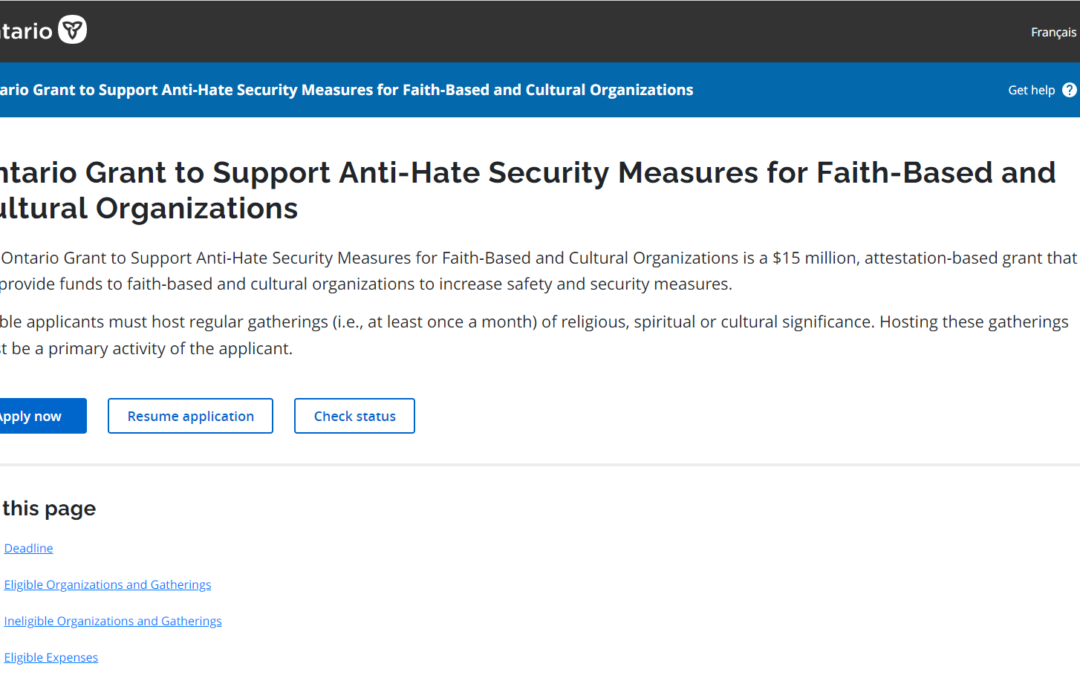
The Ontario Grant to Support Anti-Hate Security Measures for Faith-Based and Cultural Organizations is now accepting applications for 2022-23. Organizations that applied for the grant in 2021-22 can apply again for 2022-23.
The deadline to apply is August 31, 2022 at 11:59 p.m. EST.
As with the previous round of the program, the grant can go towards expenses such as security equipment or training to respond to hate-motivated incidents. Funds must be spent on eligible expenses by March 31, 2023.
Further information can be found on the website. For additional questions or help, please contact ServiceOntario. Call centres are open Monday to Friday, 8:30 a.m. to 5:00 p.m., excluding government and statutory holidays:
Toll-free: 1-855-216-3090
Toll-free TTY: 1-800-268-7095
Ontario Grant to Support Anti-Hate Security Measures for Faith-Based and Cultural Organizations
COVID POLICIES from the National Office of The United Church of Canada
With restrictions easing across the country, the United Church sought the advice of outside legal counsel for communities of faith. Excerpts from the legal opinion are provided below. Please note it is based on policies currently in place and the assessment of them as reasonable.
Assuming that the original rule issued by the Church or congregation concerning masking or proof of vaccination status was reasonable, there is nothing about the removal of the various provincial mandates that would make it improper or illegal to continue with a rule that required masking or proof of vaccination status. In fact, pursuant to relevant Occupational Health and Safety legislation,
employers have a duty to take every precaution reasonable in the circumstances to keep workers safe.
For at least some time, we suspect that there is a good argument that a continuation of restrictions, such as masking, (and possibly a vaccination policy, depending on its requirements) is reasonable.
Please note these considerations will depend on the actual vaccination policy that has been implemented, as it could vary. COVID-19 restrictions implemented by congregations and other measures, such as masking, are generally founded on obligations pursuant to relevant Occupational Health and Safety legislation. Accordingly, the Church (and its congregations) continue to be subject to their obligations pursuant to the relevant Occupational Health and Safety legislation in each applicable province…
Any vaccination policies that are currently in place will also have specific considerations, as they often require the disclosure of vaccination status.
These policies will need to be reasonably balanced. Any collection of vaccination status should only be done as part of a reasonable vaccination program that appropriately balances the rights to privacy and bodily integrity of its employee’s and congregant’s legitimate interests and obligations. To continue with a vaccination policy, the congregation would need to ultimately determine that it is reasonable in the circumstances. This will be a contextual analysis that balances the privacy interests of the employees and/or congregants with the actual policy.
Relying on applicable Occupational Health and Safety legislation requires that current measures be supported by current and up to date science in order to support that the policy makes the workplace “safe” and is a “reasonable precaution”, in the words of the Ontario statute vaccination policy requirements…
Depending on how the pandemic and scientific evidence continues to unfold, it may be more challenging to assert they are required though. Masking or other COVID-19 requirements follow a similar analysis. The congregation or Church should be considering whether such requirements are necessary to ensure a safe workplace.
Requiring masking or sanitization are certainly less intrusive measures than requesting vaccination status, so can generally be more easily justified…
We would caution that the requirement to mask should apply equally to all employees and congregants, regardless of their vaccination status… The above noted conclusions could change as scientific evidence and public health guidance evolve. Having said that, the Church can currently proceed with reasonable restrictions. Without a detailed review of vaccination policies/practices in place, it is challenging to opine on whether specific vaccination related restrictions would remain reasonable. However, masking/sanitizing would be a reasonable restriction as of the date of this opinion.
Congregations are reminded to continue to ask people to stay home if unwell or if they have tested positive for COVID.
In the summer of 2018, Diane Blanchard accepted the invitation to serve as Minister, Pastoral Relations, for Antler River Watershed, Western Ontario Waterways and Horseshoe Falls Regional Councils starting on January 1, 2019.
As if the structural change was not enough to manage, the church also chose that date to implement a new search and selection system called ChurchHub. Diane shepherded congregations through the ChurchHub process in the early days and still resources them now. She trained Liaisons, new regional council partners with communities of faith that are in search.
Diane also resourced Human Resources Commissions to learn their new role and become confident in their work. While doing all of that, she proved a valuable teammate and advisor to her regional council colleagues.
Some of the strengths Diane brings to this role are her international experiences, long service in pastoral relationships, extensive Presbytery work and skills and training in therapy. We are grateful for the commitment she made to launching our regional councils!!!!
Diane recently communicated her desire to retire as of August 30, 2022. We will celebrate her leadership closer to her leave-taking. Keep checking newsletters for information.
Searching for our next Minister, Pastoral Relations
We hope to offer a one-month overlap with Diane for the person entering this role. To be able to do that and to honour 90 days notice to a community of faith if needed, we need to have this person in place by April 30, 2022.
The deadline for submissions is March 30, 2022. Anyone submitting an application is asked to be available for the interview dates of April 6 and 7. Thank you.
Antler River Watershed Regional Council Members Let Sunflower Seeds of Hope Abound in ARWRC
Sunflowers! The national flower of Ukraine.
When explorers returning home from North America brought sunflower seeds with them, the seeds were planted in the rich dark soil of Ukraine where they flourished. While other fats and oils used for cooking were forbidden by the Orthodox Church during Lent, the oil from sunflower seeds found its way into Ukrainian cooking and culture. Throughout Ukraine’s history the ubiquitous sunflower has been a symbol of peace.
Since late February the sunflower has become a global symbol of resistance and solidarity in support of Ukraine. It is rooted in a news story about a bold, brave and courageous Ukrainian woman who offered sunflower seeds to heavily armed Russian soldiers invading her country. “Take these seeds,” she said, “so that sunflowers grow when you die here.”
Sunflower seeds of hope … hope that good will triumph; hope that through the darkness beauty will grow. Death and resurrection.
On Ash Wednesday, on behalf of the Antler River Watershed Regional Council (ARWRC), I wrote a letter of support to the Ukrainian faith communities located within the region.
Here is an excerpt:
We watch with dismay and disbelief as Russia continues to invade Ukraine. Our hearts ache because of the violence, death, pain, destruction, and the displacement being visited upon Ukraine’s people, many of whom have family members and friends living in Canada.
In a time such as this, we pray that the Spirit of God’s love will provide strength for the people, political leaders and spiritual leaders of Ukraine. We pray for peace.
We are holding and encouraging you as we stand in solidarity with you. support
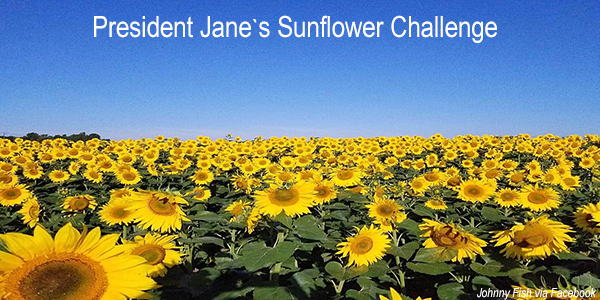
And now to the Sunflower Challenge!
During Lent, and beyond, I encourage all communities of faith to plant sunflower seeds of hope and to adorn your worship spaces with sunflowers … be they real ones, photographs or made of construction paper. My hope is that the ARWRC will become a field of sunflowers. It will become an expression of our “Voices United” in hope and in solidarity with the people of Ukraine and their loved ones around the world.
Beyond the sunflowers, please also check the UCC website for many more ways to help and show support for Ukraine and its people.
In Faith & Hope,
Rev. Jane Van Patter
President, Antler River Watershed Regional Council
The group is mandated to consider ways congregations can engage with the United Nations Second International Decade for People of African Descent, and to name realities of anti-Black racism and… continue reading
Moderator Rev. Kimberly Heath shares a personal reflection on participating in the National Day for Truth and Reconciliation ceremony on Parliament Hill.
Partners meeting with United Church of Canada communities of faith, Canadian partners, ecumenical and civil society organizations, and Canadian government officials
Indigenous-Racialized youth and young scholars share wisdom and learn about each other’s identities, cultures, and spirituality while decentering colonial narratives
On August 12, 10 people were handed removal orders after being identified at a protest in Calgary, the first time Canada’s federal immigration enforcement has targeted people at a protest. The United… continue reading
Manage Consent
To provide the best experiences, we use technologies like cookies to store and/or access device information. Consenting to these technologies will allow us to process data such as browsing behavior or unique IDs on this site. Not consenting or withdrawing consent, may adversely affect certain features and functions.
Functional
Always active
The technical storage or access is strictly necessary for the legitimate purpose of enabling the use of a specific service explicitly requested by the subscriber or user, or for the sole purpose of carrying out the transmission of a communication over an electronic communications network.
Preferences
The technical storage or access is necessary for the legitimate purpose of storing preferences that are not requested by the subscriber or user.
Statistics
The technical storage or access that is used exclusively for statistical purposes.The technical storage or access that is used exclusively for anonymous statistical purposes. Without a subpoena, voluntary compliance on the part of your Internet Service Provider, or additional records from a third party, information stored or retrieved for this purpose alone cannot usually be used to identify you.
Marketing
The technical storage or access is required to create user profiles to send advertising, or to track the user on a website or across several websites for similar marketing purposes.